
Time Tracking and Shift Management: HR Administration

Depending on company operations, across various industries, accurate time tracking and efficient shift management are critical — and it's no longer just an administrative task for the HR department. This is a business process that directly impacts payroll accuracy, employee satisfaction, labor law compliance, and ultimately — the company's financial performance.
Excel spreadsheets, paper chaos, and manual calculations no longer meet modern business needs. Studies show that 57% of employees believe inaccurate time tracking is a major problem that causes dissatisfaction and erodes trust.
What is Time Tracking and Why Is It Important
Time tracking and shift management is a systematic approach that comprehensively covers employee work hours, breaks, overtime, night shifts, and vacation time.
For modern businesses, this means:
Operational Efficiency — proper shift planning ensures optimal staffing levels
Payroll Accuracy — salaries are calculated precisely based on actual hours worked and overtime
Labor Law Compliance — automatic monitoring of overtime, rest days, and leave tracking
How Modern Time Tracking Systems Work
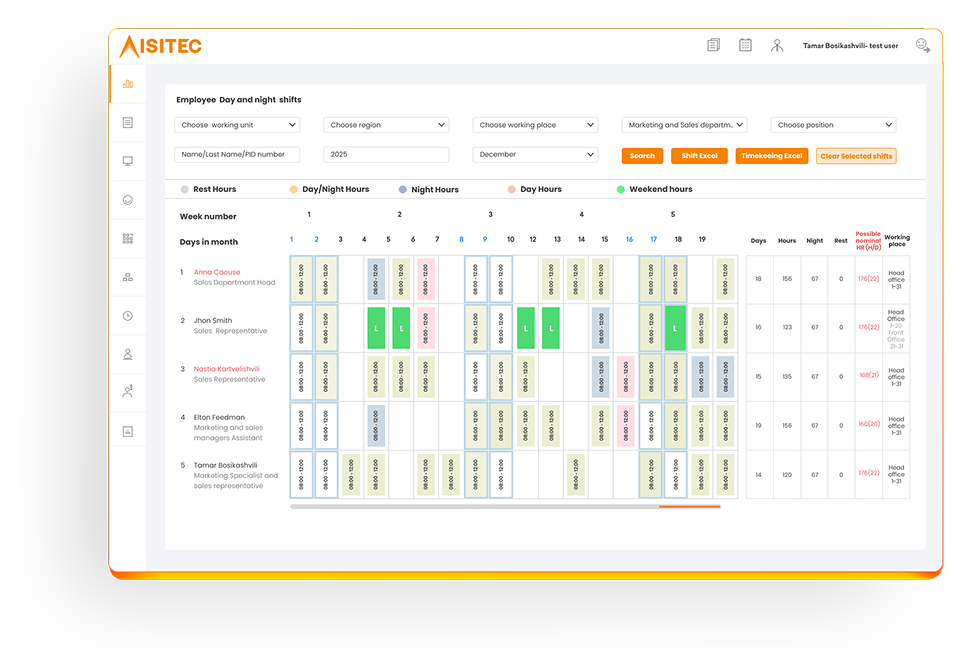
Digital HR platforms create an integrated ecosystem for time tracking:
Automatic Calendar Generation
The system creates an employee's work calendar based on contract terms: daily and weekly working hours, work days, rest schedule, and overtime calculation rules. Employees see their schedule in real-time.
Automatic Calculation and Monitoring
The system automatically calculates and records:
Overtime hours (according to the Labor Code)
Night shift premiums
Weekend work coefficients
Break times
Absences
Integration with Payroll
Time tracking data automatically transfers to the Payroll module, ensuring accurate and timely salary calculations.
How to Improve Time Tracking
Move to a Fully Digital System
Excel spreadsheets and manual entry create errors and waste time. Digital HR systems reduce errors by 60-80% and free up HR teams for strategic tasks.
Employees or authorized personnel should be able to:
View their own or team schedules
Plan, manage, and record absences
Request leave
Swap shifts with colleagues
Self-service functionality increases employee satisfaction and reduces administrative burden.
Employees should know:
How work hours are recorded
When lateness is counted
How overtime is compensated
Transparency builds trust.
Monitoring and Analytics
Regularly analyze:
Paid and unpaid absences
Overtime trends
Shift coverage efficiency
Labor cost dynamics
Shift Management Specifics
For shift-based businesses (24/7 operations, retail, hospitality), it's critical to have:
Early Schedule Planning — employees should know their shift schedule at least 2 weeks in advance, allowing them to plan personal life.
Flexibility and Swap Options — ability to swap shifts with colleagues.
Overtime Prevention — the system should alert managers when an employee approaches contracted work hour limits.
Fair Rotation — equitable distribution of day and night shifts, weekends and holidays across the team.
Common Mistakes to Avoid
Mistake #1: Maintaining Manual Processes
Despite having a digital system, keeping Excel backups or duplicating on paper creates additional errors and wastes time.
Mistake #2: Incorrect Approval/Workflow
If monthly time reports aren't approved by the responsible parties, the risk of discrepancies and disputes during Payroll increases.
Mistake #3: Excluding Employees
If the system is complex or unintuitive, employees will be dissatisfied and resistance will emerge. A user-friendly interface is critical.
Aisitec HR's Time Tracking and Shift Module
Aisitec HR offers a complete time tracking platform designed for Georgian business needs:
Automatic Calendar — generated based on contract terms, employees and managers can edit as needed.
Automatic Shift Planning — flexible management of 24-hour shifts, day/night shifts, weekend shifts.
Automatic Overtime Calculation — the system calculates all overtime hours according to the Labor Code.
Night and Weekend Premiums — automatically calculated and reflected in Payroll.
Reporting and Analytics — detailed reports by time, department, and project.
All of this is integrated with Aisitec's complete HR system, meaning seamless integration with payroll, leave, performance reviews, and analytics.
Conclusion
Time tracking and shift management in 2026 is now a mandatory digital process directly tied to business efficiency. Manual systems create errors, increase costs, and hinder HR teams' strategic work.
A modern digital platform ensures accuracy, transparency, labor law compliance, and high employee satisfaction.
If you want to digitize time tracking and shift management in your organization, request a 14-day free demo and discover Aisitec HR's capabilities.


Tamar, I liked your point about accurate time tracking making shift management easier. Having quick access to schedules is especially helpful for retail employees, and the Dollar Tree Compass login page allows them to access their account and check their shift timings with their Employee ID and password.